Level 3 Diploma in Health and Social Care (RQF / NVQ)
An Ofqual-regulated Qualifi qualification for care assistants, support workers and healthcare assistants. Study 100% online through assignments, with no exams to sit. The qualification also carries UCAS points, and you can spread the cost with instalment plans.
Level 3 Health and Social Care Course - 100% Online Study
The Qualifi Level 3 Diploma in Health and Social Care (QAN 603/0819/9) is designed for people who already work in care, or who want to move into it, and are ready to build the knowledge needed for more senior roles. On this health and social care level 3 course you study six units: four core units covering how care services are organised, communication, promoting health and person-centred care, plus two specialist units chosen from diabetes care, stroke care and dementia care. Together the units build up 60 credits, equal to 600 hours of total qualification time. Most learners finish in 6 to 9 months, and a fast-track option is available if you want to complete sooner.
✓TOTUM student membership registration available, giving you access to a range of student discounts and offers
✓Flexible instalment options available
✓100% online learning
✓Assignment-based assessment, no exams
✓All assessment fees included
✓Free resubmissions included
✓E-certificate included
✓Tutor support and feedback included
✓Study flexibly around work and other commitments
Units You Will Study (60 Credits)
Code
Unit
Credits
HSC301
An Introduction to Health and Social Care
10
HSC302
Communication for Health and Social Care
10
HSC303
Promoting Health in the Population
10
HSC304
Person-Centred Care
10
HSC305
Understanding Diabetes Care (optional)
10
HSC306
Understanding Stroke Care (optional)
10
HSC307
Understanding Dementia Care (optional)
10
4 mandatory units + 2 optional units = 60 credits.
What Will You Study on the QUALIFI Level 3 Diploma in
Health and Social Care?
The QUALIFI Level 3 Diploma in Health and Social Care at West London Professional College (WLPC) introduces the knowledge and values behind compassionate, professional care. Explore the mandatory and optional units below to understand how each subject connects to supporting people in health and social care settings.
An Introduction to Health and Social Care – Mandatory Unit
Build your understanding of how UK health and social care services are organised and how they meet different people’s needs. Explore the roles of care workers and other professionals, including how their responsibilities contribute to a person’s overall support. Discover why dignity, respect and fairness are essential when helping people with everyday care needs. Learn about safeguarding, confidentiality and reporting poor practice, alongside the role of organisations that monitor care standards. Consider how professionals work together to provide coordinated support and maintain confidence in care services. This introductory unit provides a foundation for your Level 3 health and social care studies and helps you understand what working in care involves.
Communication for Health and Social Care – Mandatory Unit
Explore how effective communication in health and social care helps people feel listened to, understood and involved. Learn to communicate clearly and respectfully with service users, relatives, carers and colleagues in different situations. Consider how your choice of words, tone and body language can influence someone’s confidence and willingness to share concerns. Discover ways to adapt communication for people who need additional support to express their wishes or understand information. Develop written and presentation skills, while exploring digital communication, confidentiality and responsible information sharing. This unit helps you approach conversations with greater awareness and build the communication skills relevant to care and support roles.
Promoting Health in the Population – Mandatory Unit
Discover how health promotion helps individuals and communities understand the choices that influence their wellbeing. Explore the relationship between lifestyle, living conditions and health, including why some people face greater barriers to healthy living. Consider how everyday habits and the environment around a person can affect their opportunities to make positive changes. Learn how public health campaigns communicate information and encourage people to take an active interest in their health. Explore public health policy and develop a small health promotion campaign for a chosen audience. This unit broadens your understanding of preventive care and the contribution health and social care workers can make to healthier communities.
Person-Centred Care – Mandatory Unit
Understand how person-centred care places each individual’s needs, wishes and preferences at the heart of their support. Explore why listening to what matters to a person is essential when planning care and discussing everyday decisions. Learn how respect for personal choices can help people retain a sense of independence and control over their lives. Consider how care should respond to the individual, recognising that people with similar needs may want different kinds of support.
Examine empathy, equality, ethical dilemmas and the balance between personal choice and risk in care delivery. This unit helps you develop a thoughtful approach to health and social care that values people as active participants in their own care.
Understanding Diabetes Care – Optional Unit
Develop your understanding of diabetes care, with a particular focus on Type 2 diabetes and its effects on everyday life. Explore the condition’s causes, symptoms, diagnostic investigations and possible long-term complications. Learn about treatment and support, including the place of diet, lifestyle and medication in diabetes management. Consider what it can feel like to adjust to a long-term condition and why sensitive, respectful support matters. Explore how care workers can encourage individuals to remain involved in their daily routines and decisions about support. This optional unit builds your awareness of the needs of people living with diabetes within the wider context of health and social care.
Understanding Stroke Care – Optional Unit
Build your understanding of stroke care and the support a person may need during recovery and everyday life afterwards. Explore different types of stroke, risk factors and the investigations used in diagnosis. Learn about possible effects on movement, speech and swallowing, alongside acute care and rehabilitation.
Consider how changes following a stroke can influence a person’s confidence, independence and experience of daily activities. Explore why patient communication and support tailored to the individual are important for stroke survivors and their families. This optional unit develops your awareness of stroke recovery and the importance of respectful, coordinated health and social care support.
Understanding Dementia Care – Optional Unit
Develop your understanding of dementia care and how changes in memory and thinking can affect a person’s everyday experiences. Explore why people living with dementia may need different levels and types of support as their needs change. Learn why patience, reassurance and respectful communication are central to helping someone feel heard and valued. Consider how a person’s wishes, familiar preferences and individual identity should remain central to their care.
Explore the importance of recognising the person beyond their condition when supporting daily activities and personal choices. This optional unit strengthens your understanding of compassionate dementia support and the value of a person-centred approach in health and social care.
Student Benefit
UK's #1 Student Discount Card
All enrolled West London Professional College students are eligible to apply for an official TOTUM membership to unlock exclusive everyday savings.
✓Save an average of £550+ per year
✓500+ top UK brands (Apple, ASOS, Boots, Samsung)
✓Free government-approved 18+ PASS Proof of Age ID
Work experience route: Relevant paid or voluntary experience in a health, care home, hospital, or support setting (you can enrol without a Level 2 certificate if you have sector experience)
Age & English language: Learners should be aged 16 or over with a good standard of written English to complete the online assignments
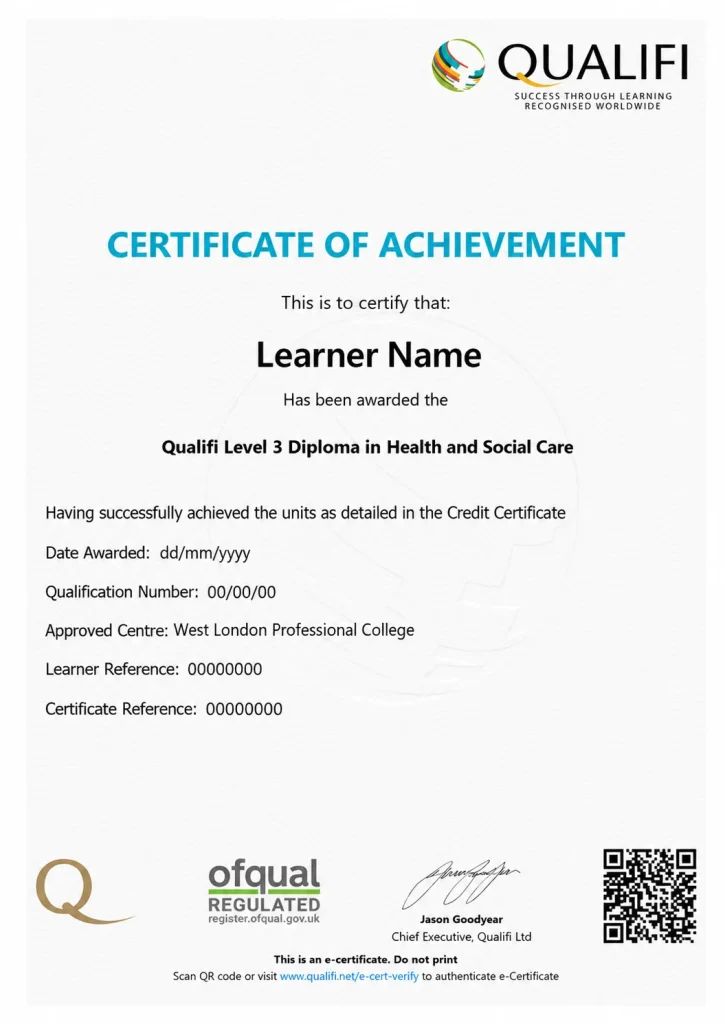
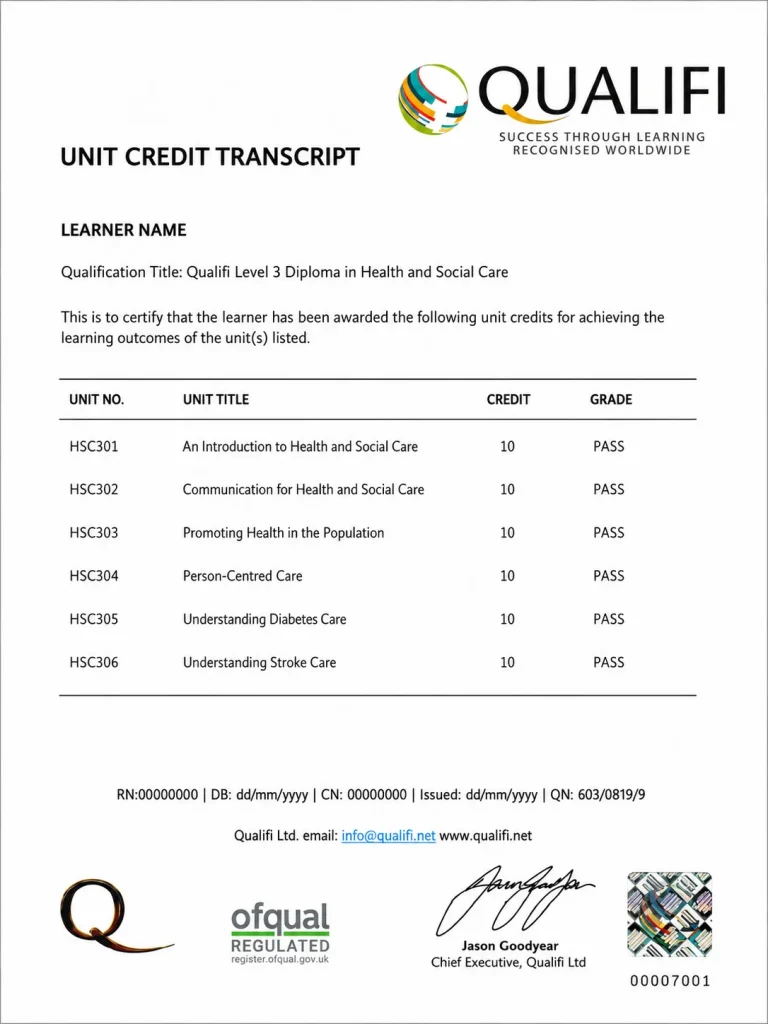
Sample Certificate
When you complete the course, Qualifi issues your e-certificate together with a unit credit transcript showing every unit you passed, so employers can verify your qualification.
England · Sector insights · 2024/25
Health and Social Care: A Sector That Needs Skilled People
Exploring a Level 3 Health and Social Care course?
These adult social care figures show the scale of the sector
in England and the importance of workforce learning and development.
££77.8bn
Economic contribution
Estimated contribution of adult social care to England’s
economy in 2024/25.
111,000
Vacant posts
Estimated vacancies across adult social care in England
in 2024/25.
470,000
Additional posts by 2040
Projected need if the workforce grows in line with the
population aged 65 and over — approximately
27%
growth.
Qualifications and workforce development
Reported Level 2 qualification figures for care and support workers.
38%Level 2
38%
of care and support workers held a Level 2
qualification in 2024/25.
This compares with
41%
in 2023/24 and
48%
in 2018/19.
48%2018/19
41%2023/24
38%2024/25
Adult social care workforce
Sector size and gender profile in England, 2024/25.
1.71 milliontotal posts
Includes filled and vacant posts; approximately
1.6 million
posts were filled.
78%
Female
22%
Male
Source: Skills for Care,
The state of the adult social care sector and workforce
in England
,
2025, using 2024/25 data.
Figures relate to adult social care in England, rather than the
entire UK health and social care sector.
Future workforce figures are projections.
Read the Skills for Care publication
.
FAQs
1. How long does the Level 3 Diploma in Health and Social Care take?
The qualification carries 60 credits (600 hours Total Qualification Time). Most learners complete the course online in 6 to 9 months, studying at their own pace around shift work, and a fast-track option is available if you want to finish sooner.
2. Is this the same as an NVQ Level 3 in Health and Social Care?
Not exactly. NVQs belonged to the old framework, which the RQF (Regulated Qualifications Framework) replaced. This Qualifi diploma is the current regulated Level 3 qualification: it covers the knowledge needed for senior care roles but is assessed through written assignments rather than workplace observation, so you do not need to be observed in a care setting to complete it. It is a full Level 3 diploma with 60 credits.
3. Do you need a work placement for Level 3 Health and Social Care?
No. No placement evidence is required. If you already work in care, you can draw on your experience in your assignments.
4. What is the Level 3 Diploma in Health and Social Care equivalent to?
It is Level 3 on the RQF, the same standard as A-level study. It carries 60 credits and can support university progression, or progression to the Level 4 Diploma in Health and Social Care.
5. Are there any exams on this Level 3 Health and Social Care course?
No. You are assessed entirely through written assignments, marked by qualified assessors and internally verified.
6. What jobs can you get with a Health and Social Care Level 3 qualification?
Care assistant, support worker, healthcare assistant, and progression towards senior care assistant and team leader roles.
7. How much does the Level 3 Health and Social Care course cost?
Qualifi, an Ofqual-regulated awarding organisation. Qualification number 603/0819/9
9. How can I find health and social care jobs?
Search for vacancies on NHS Jobs and the government’s Find a job service. You can also check the careers pages of local NHS trusts, councils, care homes and support providers.
Try search terms such as healthcare assistant, care assistant, support worker and residential support worker, and filter by location and experience level. Read each job description carefully and tailor your application to show how your skills, experience and qualifications meet the person specification.
We encourage you to apply for suitable roles after completing your Health and Social Care qualification. It can help you demonstrate relevant knowledge to employers, although it does not guarantee a job. Requirements vary, so check each vacancy carefully.
Our Process
Step 1: Enrol in Your Course
Apply online through the Book Now panel on this page and pay the course fee, or spread the cost with instalment plans at checkout. Once your enrolment is confirmed, our admissions team will contact you and give you access to the WLPC learning portal.
Step 2: Study Online at your own Pace
Learn 100% online through the WLPC learning portal over 6 to 9 months, with a fast-track option if you want to finish sooner. You complete six units through written assignments, with feedback from your assessor on each one. There are no exams, and no work placement is required.
Step 3: Receive Your Qualifi Certificate
When all six units are passed and internally verified, Qualifi issues your Ofqual-regulated Level 3 Diploma certificate.
UK-recognised Qualifications – study online, flexible, worldwide.
Level 2 Diploma in Care
Entry-level foundation for care assistants & support workers
£1,500Course Fees
Level 4 Diploma in Health and Social Care
Year 1 equivalent – progress to senior care and management
£750Course Fees
Level 5 Diploma in Health and Social Care
Year 2 equivalent – leading to advanced roles & top-up degrees
£850Course Fees
Shopping Cart
Manage Consent
To provide the best experiences, we use technologies like cookies to store and/or access device information. Consenting to these technologies will allow us to process data such as browsing behavior or unique IDs on this site. Not consenting or withdrawing consent, may adversely affect certain features and functions.
Functional
Always active
The technical storage or access is strictly necessary for the legitimate purpose of enabling the use of a specific service explicitly requested by the subscriber or user, or for the sole purpose of carrying out the transmission of a communication over an electronic communications network.
Preferences
The technical storage or access is necessary for the legitimate purpose of storing preferences that are not requested by the subscriber or user.
Statistics
The technical storage or access that is used exclusively for statistical purposes.The technical storage or access that is used exclusively for anonymous statistical purposes. Without a subpoena, voluntary compliance on the part of your Internet Service Provider, or additional records from a third party, information stored or retrieved for this purpose alone cannot usually be used to identify you.
Marketing
The technical storage or access is required to create user profiles to send advertising, or to track the user on a website or across several websites for similar marketing purposes.